How Outdoor Wall Lighting Can Transform the Safety, Style and Functionality of Your Home
Discover how outdoor wall lighting can transform your home's safety, style, and functionality with better visibility, curb appeal, security, and outdoor comfort.
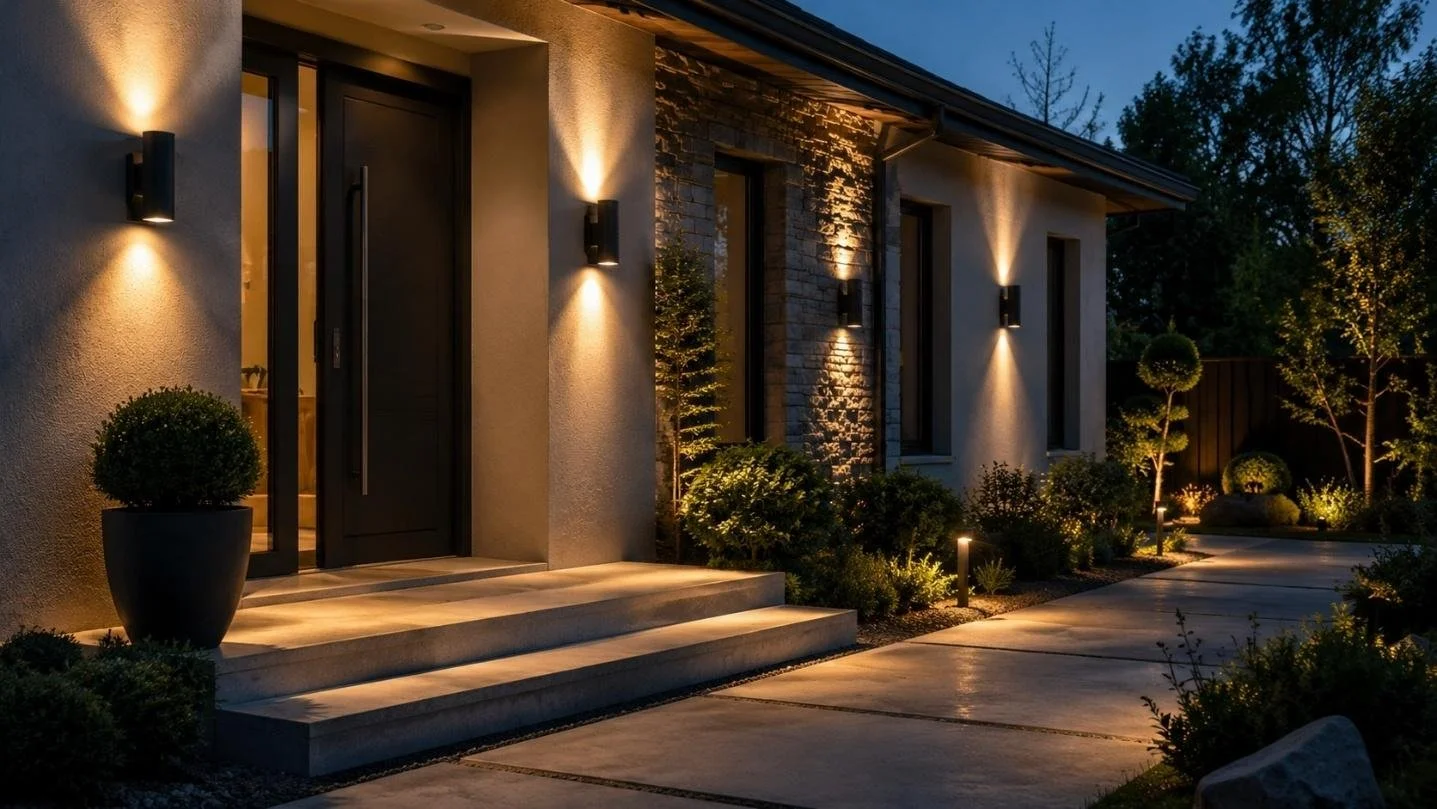
Outdoor lighting is often treated as a finishing touch, yet it plays a much more important role in the design and everyday use of a property. The right wall lights can improve visibility around entrances, make outdoor spaces safer after dark and enhance architectural details that might otherwise disappear at night.
For homeowners, designers and property developers, choosing exterior lighting requires more thought than simply finding a fixture that looks attractive. Weather resistance, positioning, brightness, energy efficiency and the way light interacts with the building all influence the final result.
A useful starting point is to explore the different styles and configurations available from specialist lighting suppliers such as lightingconcept.co.uk. Comparing purpose-designed outdoor wall lights helps clarify important differences between decorative fittings, practical entrance lighting and fixtures intended to illuminate larger exterior areas. This makes it easier to select lighting according to both the architecture of the property and the practical requirements of each location.
Why Outdoor Wall Lighting Matters
Exterior wall lights perform several functions simultaneously. Their most obvious purpose is visibility. Entrances, paths, steps, driveways and terraces become easier to navigate when they are properly illuminated.
However, effective lighting is not simply about producing as much light as possible. Excessively bright fixtures can create glare, uncomfortable contrasts and unwanted light spill. A carefully designed scheme distributes light where it is useful while maintaining a comfortable atmosphere.
Lighting also changes how a building is perceived after sunset. During daylight hours, materials, proportions and architectural details naturally define the appearance of a property. At night, lighting takes over much of this role.
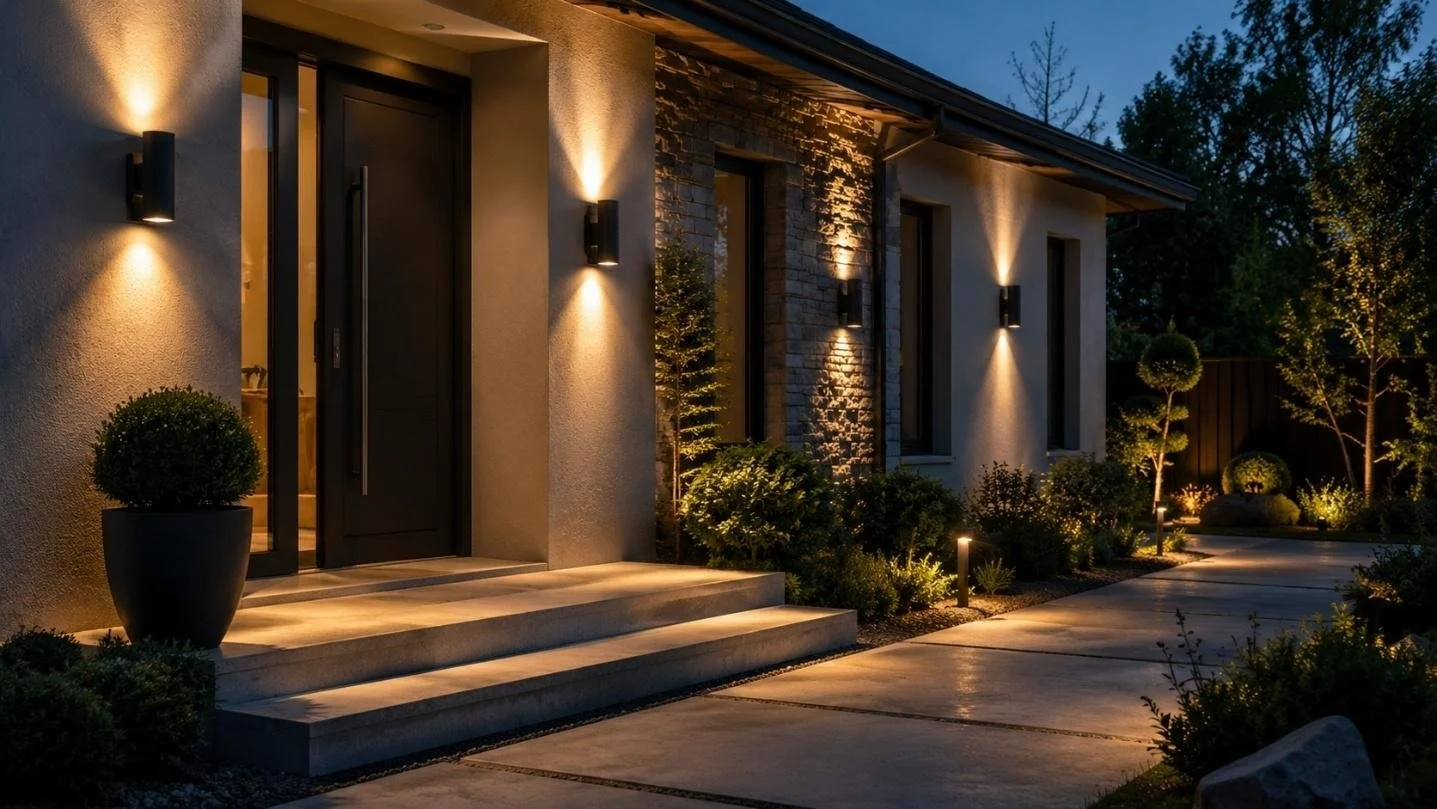
A well-positioned wall light can highlight brickwork, stone, timber, rendering or other exterior finishes. Multiple fixtures can also reinforce the proportions of a façade, drawing attention to doorways, columns or symmetrical architectural features.
Choosing the Right Type of Outdoor Wall Light
Outdoor wall lights are available in a wide range of formats, and the best choice depends heavily on their intended purpose.
Traditional lantern-inspired fixtures are particularly suitable for period properties, cottages and homes with classical architectural features. Contemporary buildings often benefit from cleaner geometric designs with discreet housings and controlled beams.
Up-and-down wall lights are another popular option. These fixtures project light vertically in both directions, creating distinctive patterns across exterior walls. They can be especially effective when repeated along a façade or boundary wall.
Directional fittings are more practical when a particular feature or area needs illumination. They may be used to highlight an entrance, illuminate a path or provide additional visibility near a garage.
Before selecting a fixture, consider:
The architectural style and exterior materials of the property
The area that actually needs illumination
The desired brightness and colour temperature
Exposure to rain, moisture and changing weather conditions
Energy consumption and expected operating hours
Whether sensors, timers or smart controls would be beneficial
Considering these factors together produces a more coherent result than choosing each light purely on appearance.
Understanding IP Ratings for Exterior Lighting
Weather resistance is one of the most important technical considerations when selecting outdoor lighting.
Exterior electrical fixtures are commonly classified using an IP, or Ingress Protection, rating. This indicates the level of protection provided against solid objects and moisture.
The appropriate rating depends on where the fitting will be installed. A light positioned beneath a substantial covered porch may experience considerably less direct exposure to rain than one mounted on an open garden wall.
This distinction matters because outdoor environments can be demanding. Rain is only one factor. Condensation, dust, temperature changes and wind-driven moisture can all affect fixtures over time.
For this reason, buyers should always check that a fitting is specifically designed and appropriately rated for its intended exterior location rather than assuming that any enclosed light fixture can be installed outdoors.
Positioning Outdoor Wall Lights Effectively
Even a high-quality fixture can perform poorly if it is installed in the wrong position.
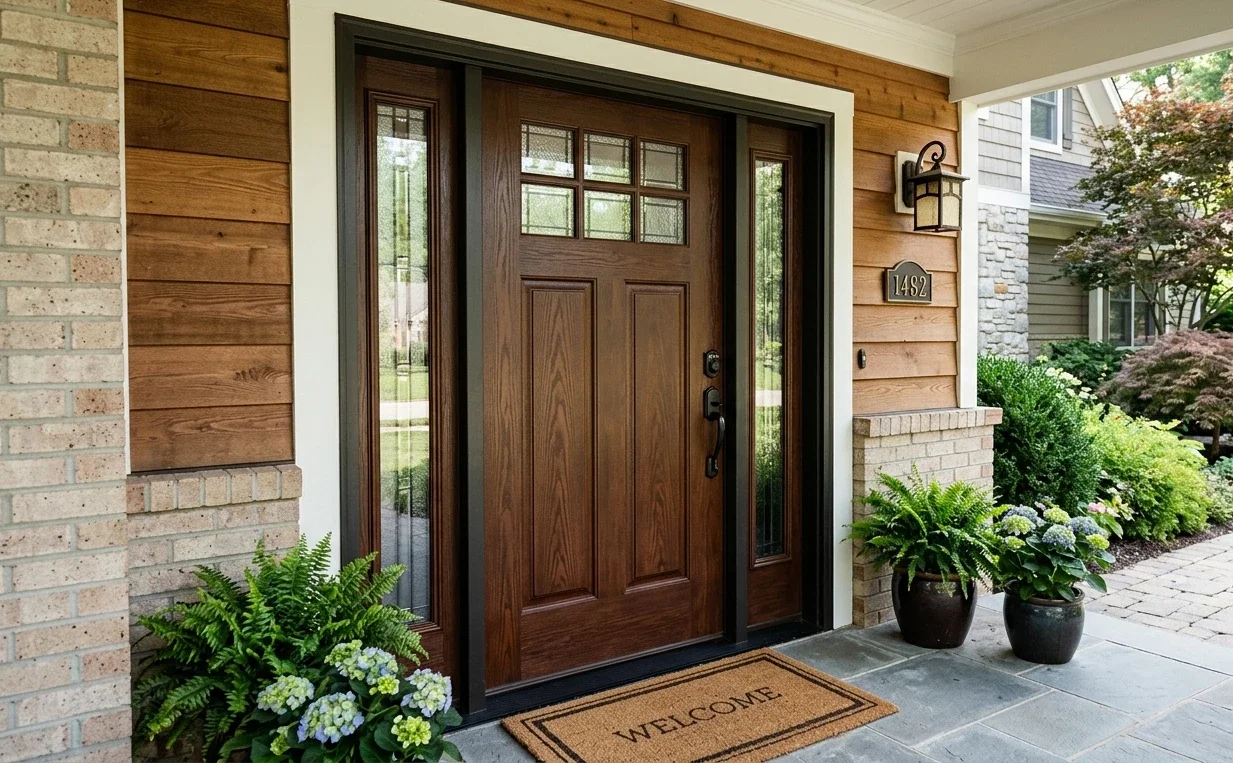
Entrance lighting should provide enough illumination for people to approach the door, identify steps and use locks comfortably without creating glare at eye level. Where space permits, installing lights on both sides of a doorway can create balanced illumination while strengthening the visual symmetry of the entrance.
Along larger walls, spacing becomes particularly important. Fixtures positioned too closely together can make the façade appear excessively bright, while lights placed too far apart may create isolated pools of illumination separated by dark areas.
The beam pattern should also be considered. Some fixtures distribute light broadly, while others create narrow, defined beams. Looking at the projected light rather than simply the physical dimensions of the fitting is essential when planning the installation.
Think About the View From Inside
Exterior lighting should not be considered exclusively from outside the property.
Strong lights positioned opposite windows can become distracting when viewed from bedrooms or living spaces. Likewise, poorly directed fixtures may produce reflections on glazing.
A successful lighting plan considers both perspectives. The exterior should feel welcoming and safe while remaining visually comfortable for people inside the home.
Using Light to Enhance Architecture
One of the most effective uses of wall lighting is architectural enhancement.
Textured materials are particularly responsive to carefully positioned light. When illumination travels across brick, natural stone or textured render, small shadows reveal the depth and character of the surface.
Modern architecture can benefit from a different approach. Minimalist wall lights with defined beams can emphasise strong lines and geometric forms without adding unnecessary visual clutter during the day.
Consistency is important when several fixtures are visible together. Repeating the same design, finish or light temperature across a façade generally creates a more deliberate appearance.
That does not mean every exterior fixture needs to be identical. Entrance lights, terrace lighting and pathway illumination can serve different purposes, but they should still feel like elements of the same overall design.
Selecting the Right Colour Temperature
Colour temperature has a significant influence on atmosphere.
Warm white light tends to create a comfortable, welcoming appearance and works particularly well with brick, timber and warmer stone finishes. Cooler light can provide a sharper contemporary appearance, although it should be used carefully in residential environments where comfort is a priority.
Consistency is usually more important than selecting one specific temperature. Mixing noticeably different colour temperatures across neighbouring fixtures can make an otherwise carefully designed exterior look fragmented.
It is therefore useful to plan the entire visible lighting scheme before purchasing individual fittings.
Energy Efficiency and Smart Lighting Controls
Because exterior lights may operate for several hours every evening, energy efficiency should be part of the selection process.
LED technology has become particularly practical for outdoor applications because it combines relatively low energy consumption with long operating life. This can reduce both electricity use and the frequency with which lamps need to be replaced.
Controls can improve efficiency further.
Motion sensors are useful in areas where continuous illumination is unnecessary, such as side passages or secondary entrances. Dusk-to-dawn sensors automatically respond to ambient light levels, while timers can restrict operation to particular hours.
Smart lighting systems offer additional flexibility, including remote control and scheduled operation. The most sophisticated system is not necessarily the best one, however. Controls should match the way the space is actually used.
Avoiding Common Exterior Lighting Mistakes
A common mistake is trying to illuminate every part of a property equally. Effective exterior lighting usually depends on contrast. Entrances and important circulation areas can receive stronger functional illumination, while secondary areas remain softer.
Another frequent problem is selecting fixtures that are too small for the building. A wall light that appears substantial in a showroom or product photograph may look disproportionately small beside a large entrance or across a broad façade.
Glare should also be considered carefully. Visible, excessively bright light sources can make an exterior space less comfortable even when they technically increase illumination.
Finally, homeowners should avoid treating each outdoor area as a completely separate project. Installing unrelated fixtures at different times can gradually produce an inconsistent collection of styles, finishes and colour temperatures.
Creating an Exterior Lighting Scheme That Lasts
Good outdoor wall lighting combines technical performance with thoughtful design. Fixtures need to withstand their environment, provide useful illumination and complement the architecture without overwhelming it.
The strongest schemes begin with purpose rather than decoration. Identify where people walk, where additional visibility is needed and which architectural features deserve emphasis. From there, suitable fixture styles, beam patterns, brightness levels and controls can be selected.
It is equally important to think beyond the appearance of a light during the daytime. The true design effect emerges after dark, when the direction, intensity and colour of illumination become part of the architecture itself.
By approaching exterior wall lighting as an integrated element of the property rather than a collection of individual fixtures, homeowners and designers can create outdoor spaces that are safer, more practical and considerably more inviting throughout the year.
Stay up to date with our latest ideas!